Market surveillance for accessibility since January 2026: companies must act now
It's official: market surveillance for digital accessibility has been running since January 2026. What this means for your company under the BFSG and why you should act now.

Summary
Since January 2026, the responsible authorities have been actively checking whether digital offerings are accessible. The legal basis is the European Accessibility Act (EAA), the Accessibility Strengthening Act (BFSG) and, as the technical benchmark, WCAG 2.2. Violations can lead to fines, civil action and loss of reputation. Companies should now review, implement and document measures for their websites and online shops, and tools such as easyMonitoring, easyVision and easyStatement help with this without a relaunch.
Market surveillance for accessibility since January 2026: companies must act now
It's official: market surveillance for digital accessibility compliance has been running since January 2026. This affects companies that fall under the Accessibility Strengthening Act (BFSG), including your company if you offer digital products or services.
Why didn't the authorities start checking websites in June 2025?
Although the Barrierefreiheitsstärkungsgesetz (BFSG) came into force on 28 June 2025, operational market surveillance was postponed until January 2026. This is due to the extensive preparations that authorities at federal and state level had to make. In addition to coordination between the responsible authorities, this also included internal training, the recruitment of specialist staff and the development of clear testing procedures.
The authorities attached great importance to establishing a legally compliant and uniform inspection process. The aim was to provide companies and institutions with binding guidance and to ensure that the checks are carried out transparently, comprehensibly and in accordance with the law. After these preparations were completed, active monitoring has been running since January 2026.
Legal basis: EAA, BFSG and the role of WCAG 2.2
The legal requirements for digital accessibility are based on European and national regulations. The European Accessibility Act (EAA) forms the basis for the BFSG, which regulates implementation in Germany. For companies, this means that digital products and services, including websites, online shops and mobile applications, must be designed to be accessible and reviewed regularly.
The international standard WCAG 2.2 (Web Content Accessibility Guidelines) provides the technical basis for assessing accessibility. These guidelines define measurable criteria for accessibility, for example in terms of contrast ratios, keyboard operability and content structure. Compliance with these standards is essential in order to meet legal requirements and minimize potential risks.
Risks for companies: avoiding fines and loss of reputation
With market surveillance now underway, the risk for companies of being confronted with fines from authorities or civil action from competitors and associations in the event of violations of digital accessibility requirements increases. The authorities are authorized to impose severe penalties if websites and digital services do not meet the minimum legal standards.
In addition to financial penalties, there is also the loss of reputation: negative media coverage, complaints from users and public lists of non-compliant providers can have a direct impact on trust and conversion rates. Companies are therefore well advised to introduce measures to ensure accessibility and to review them continuously.
SiteCockpit: your solution for the new control practice
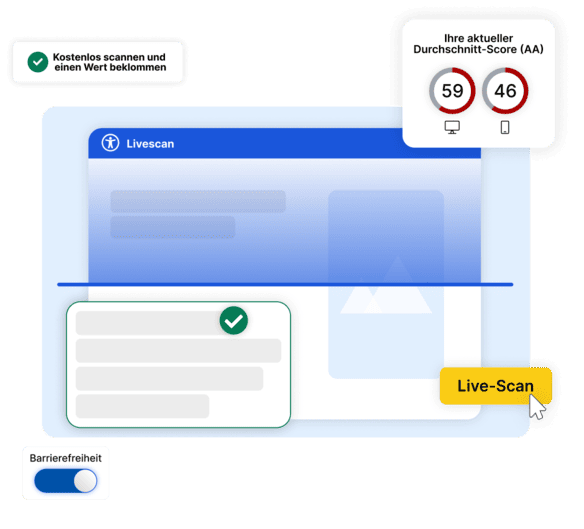
The SiteCockpit platform offers companies a central, modular solution to efficiently meet the requirements of the EAA, BFSG and WCAG 2.2. With automated monitoring (easyMonitoring), the customizable accessibility widget (easyVision) and the generator for accessibility statements aligned with legal requirements (easyStatement), websites, online shops and portals can be monitored, optimized and documented independently of the system.
SiteCockpit can be integrated in just a few minutes, no relaunch is required. The central dashboard provides companies with detailed analyses, prioritized to-dos and export options for reports in order to optimally prepare for both internal audits and external controls. Thanks to continuous monitoring, barriers are identified at an early stage and can be remedied in a targeted manner before legal consequences arise.
Why you should act now
Since market surveillance began in January 2026, the authorities have been carrying out active checks. Review your digital offerings for accessibility now and implement any necessary adjustments. By acting quickly, you minimize legal risks and avoid competitive disadvantages.
Companies also benefit from an improved user experience, greater reach and increased customer loyalty. Digital accessibility is not only a legal obligation, but also a valuable contribution to inclusion and a clear sign of innovative strength and future viability. Taking action now pays off in many ways: legally, economically and socially.
Get ready for market surveillance now
Check, optimize and document your digital accessibility with SiteCockpit, in just a few minutes and without a relaunch. This way you are prepared for official checks.
Get started with SiteCockpitRead more – Law & BFSG
.jpg)
WCAG Criteria Overview: The 4 Principles Explained Simply
All WCAG criteria explained clearly: the four principles, the three conformance levels, and what applies to your business.

One Year of the European Accessibility Act: What Enforcement in Europe Looks Like So Far
One year after the EAA took effect, cases from the Netherlands, Norway and beyond show how regulators are enforcing the rules.

Received a BFSG Warning Letter: What to Do Now
Since the BFSG took effect, warning letters alleging inaccessible websites have increased. Many are legally questionable, but you still need to respond correctl