BehiG: Digital Accessibility Becomes Mandatory in Switzerland
With the partial revision of the Equal Opportunities for Persons with Disabilities Act (BehiG), private companies in Switzerland will also be required to make their digital offerings accessible, expected from 1 January 2027. If you operate a website, online shop, or app that's publicly accessible, you're affected. SiteCockpit supports you with a modular all-in-one solution: from automated testing to AI-powered alt text and live translation.

The Key Facts at a Glance
BehiG at a Glance
These four points summarize what the BehiG partial revision regulates and why it matters for Swiss companies.
-
 Federal Council dispatch on the partial revision dated 20 December 2024
-
For the first time, the law also obligates private providers of publicly accessible services
-
Planned entry into force: 1 January 2027
-
Around 1.8 million people in Switzerland live with a disability
 Private companies covered for the first time
Based on WCAG 2.2 AA and European standards
Technically specified via the Swiss standard eCH-0059
Acting early saves costs and avoids time pressure
Private companies covered for the first time
Based on WCAG 2.2 AA and European standards
Technically specified via the Swiss standard eCH-0059
Acting early saves costs and avoids time pressure
What Is the BehiG?
The Equal Opportunities for Persons with Disabilities Act (BehiG) has been in force since 1 January 2004 and forms the legal basis for the equal treatment of people with disabilities in Switzerland. So far, the law has primarily obligated the federal government, cantons, and municipalities to make their digital offerings accessible. Private companies were barely addressed.
That is now changing fundamentally: on 20 December 2024, the Federal Council adopted the dispatch on the partial revision of the BehiG and forwarded it to parliament. The revision significantly expands the scope and, for the first time, obligates private service providers offering publicly accessible commercial or cultural services.
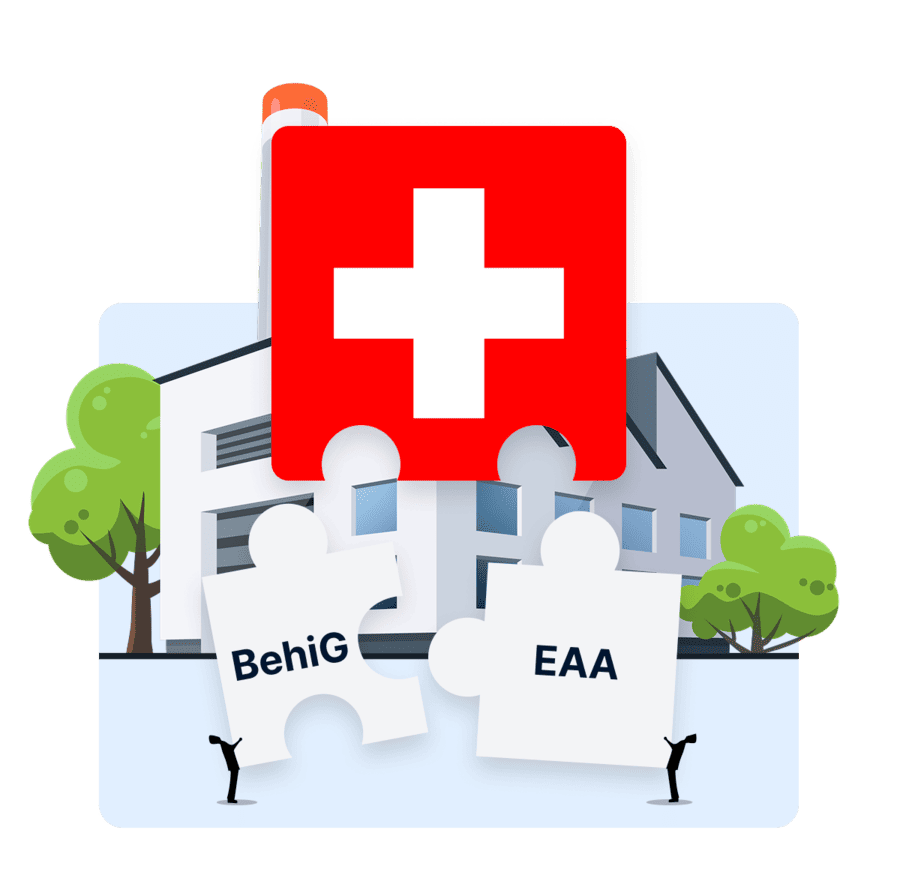
With this, Switzerland closes a gap and moves closer to European standards: while the European Accessibility Act (EAA) has applied in the EU since 28 June 2025, the revised BehiG creates comparable requirements for the Swiss market.
What Changes for Private Companies?
The BehiG partial revision brings a paradigm shift: for the first time, private providers will also be required to make their digital services accessible. What matters is whether a company offers publicly accessible commercial or cultural services – that is, services directed at an indeterminate group of users through digital channels.
The Federal Council is also to be given the authority to set binding minimum standards for digital accessibility, aligned with international and European requirements. For companies, this means: the preparation window is running.
-
Private providers of publicly accessible services are obligated for the first time
-
Covers online shops, booking portals, banking apps, hospitality apps, and digital communication services
-
The Federal Council gains the authority to set binding minimum standards
-
Companies will likely have around 1.5 years to prepare after the law is passed

Deadlines and Timeline: The Path to the Revised BehiG
The partial revision is currently going through the parliamentary process. On 28 March 2025, the National Council's Science, Education and Culture Committee (WBK-N) voted unanimously to proceed with the bill. This is a strong signal of broad political support.
-
December 2024: Federal Council adopts dispatch on the partial revision
-
March 2025: WBK-N votes unanimously to proceed
-
2026: Parliamentary deliberation in the National Council and Council of States
-
1 January 2027: planned entry into force of the revised BehiG
The planned entry into force is 1 January 2027. For companies, this means: after parliament passes the law, roughly a year and a half will likely remain to prepare. Acting now creates a decisive head start and avoids time pressure shortly before the deadline.
BehiG and the EAA: Synergies for Swiss Companies
The BehiG partial revision is deliberately aligned with European requirements: the European Accessibility Act (EAA) and EU Directive 2016/2102. For Swiss companies with customers in the EU, it's also worth noting: the EAA has applied since 28 June 2025, even to providers outside the EU, as long as they're active in the European market.
Companies preparing for the BehiG today are simultaneously meeting EAA requirements, and vice versa. Both laws are based on the WCAG guidelines (Web Content Accessibility Guidelines) and pursue the same goal: digital participation for everyone, with or without disabilities.
-
BehiG revision is aligned with EU Directives 2016/2102 and 2019/882 (EAA)
-
The EAA has applied since 28 June 2025 to Swiss companies with EU customers too
-
Both laws are based on WCAG 2.2 AA as the technical standard
-
Switzerland additionally applies the eCH-0059 standard
-
Invest once, benefit twice: BehiG compliance equals EAA compliance
Who Does the Revised BehiG Affect?
What matters is whether you offer publicly accessible commercial or cultural services through digital channels. This affects considerably more companies than many assume.
E-Commerce and Online Retail
Online shops, booking portals, e-banking, insurance portals, and any digital offering aimed at consumers. In Switzerland, one in three SMEs runs an online shop.
Hospitality and Culture
Restaurants with digital menus or self-service apps, hotels with online booking, cinemas, theaters, sports venues, and event locations with digital ticketing platforms.
Service Providers and Communication
Internet providers, digital communication services, job application portals, real estate platforms, and any company directing digital services at an indeterminate group of users.
Technical Requirements: WCAG 2.2 and eCH-0059
The technical basis for digital accessibility in Switzerland is the international Web Content Accessibility Guidelines (WCAG), version 2.2, at conformance level AA. In Switzerland, the eCH-0059 standard (version 3) specifies these requirements for the local market.
-
WCAG 2.2 AA is the international reference standard
-
eCH-0059 v3 specifies WCAG for the Swiss market
-
SiteCockpit checks automatically against these standards
WCAG is based on four core principles – perceivable, operable, understandable, and robust. You'll find a detailed explanation of these principles and the specific success criteria on our WCAG knowledge page.
SiteCockpit automatically checks your website against WCAG 2.2 AA and gives you prioritized recommendations in your dashboard. With easyAlt, you generate missing alt text automatically; with easyTranslate, you make your content accessible in multiple languages.
Prepare Now, Be Ready for 2027
Five Steps to BehiG Compliance
1. Take stock: Check your website with our free live check and identify existing barriers.
2. Set up monitoring: Activate easyMonitoring for automated, regular checks against WCAG 2.2 AA.
3. Implement quick wins: Add easyVision as an assistive widget and generate missing alt text with easyAlt.
4. Enable multilingual support: With easyTranslate, powered by DeepL, translate your website live into more than 27 languages.
5. Create documentation: Generate your accessibility statement with easyStatement, compliant with both the BehiG and the EAA.

Frequently Asked Questions About the BehiG and Digital Accessibility in Switzerland
The Equal Opportunities for Persons with Disabilities Act (BehiG) has been in force since 2004 and has so far primarily obligated the public sector (such as the federal government) to provide accessibility. The partial revision expands the scope: for the first time, private companies will also be required to make their digital offerings accessible to people with disabilities, provided they offer publicly accessible commercial or cultural services.