Avoiding BFSG Enforcement – Implement Digital Accessibility Now
Digital accessibility is no longer optional – it is a legal obligation. Companies operating websites or online shops without accessible design have been exposed to concrete legal consequences since the Accessibility Strengthening Act (BFSG) came into force – ranging from formal notices to competition law cease-and-desist warnings. SiteCockpit supports your organisation with automated auditing, legally compliant statements and frontend assistance – measurable, maintainable and GDPR-compliant.

The key facts at a glance
BFSG enforcement – the essentials
These four points summarise what you need to know about the current enforcement situation in Germany.
-
 First BFSG cease-and-desist warnings have been circulating since August 2025 – around six weeks after the law came into force
-
No court has yet decided whether the BFSG constitutes a market conduct rule under § 3a UWG – the legal situation remains unresolved
-
Since January 2026, the MLBF market surveillance authority has been conducting independent regulatory checks alongside civil enforcement
-
Fines can reach up to €100,000 depending on the severity of the violation
 Many current warnings are formally contestable according to specialist lawyers
Proactive auditing is less costly than dealing with a warning after the fact
SiteCockpit supports auditing and documentation – but does not replace legal advice
Many current warnings are formally contestable according to specialist lawyers
Proactive auditing is less costly than dealing with a warning after the fact
SiteCockpit supports auditing and documentation – but does not replace legal advice
BFSG & competition law – what does this mean for your business?
The BFSG (Accessibility Strengthening Act) has obliged many companies in Germany to implement digital accessibility since 28 June 2025. Through the Act against Unfair Competition (UWG), a violation can also become relevant under competition law – competitors, qualified associations or chambers of commerce may then issue formal warnings. Particularly at risk are:
-
Online shops, commerce platforms and digital services with a consumer focus
-
Companies with at least 10 employees or €2 million annual turnover
-
Digital contract flows, customer portals, apps or core product functions

The current enforcement situation: what is actually happening
Around six weeks after the BFSG came into force, in August 2025, the first warning letters began to circulate – including from the law firm CLAIM Rechtsanwalts GmbH, demanding a settlement amount of approximately €595. Since February 2026, the law firm MK (Michael Krause, Berlin) has also been sending warnings over alleged BFSG violations. In parallel, since January 2026 the Marktüberwachungsstelle der Länder für die Barrierefreiheit (MLBF) in Magdeburg has been conducting regulatory checks independently of any civil proceedings.
An important note on the legal context: the legal position remains unresolved. No court has yet decided whether BFSG provisions actually constitute a "market conduct rule" within the meaning of § 3a UWG – which would be the prerequisite for a valid competition law warning. Specialist lawyers therefore express significant reservations about many of the warnings currently being sent: they frequently lack a concrete description of the alleged violation, the required competitive relationship between the claimant and the company is not always identifiable, and excessive claim values are sometimes applied. The first judicial precedents are expected in the second half of 2026.
Important: These assessments do not replace individual legal advice. Whether a specific warning is valid can only be assessed by a specialist lawyer for competition or IT law on a case-by-case basis.
What to do if a warning letter arrives
Structured action instead of panic – these five steps help you respond appropriately.
Stay calm and note the deadline
Warning letters typically set a deadline of 7 to 14 days for a cease-and-desist declaration. Note the date immediately and avoid acting in panic.
Do not sign or pay anything prematurely
Signing a pre-drafted cease-and-desist declaration or making a payment prematurely can be interpreted as an admission of liability.
Engage a specialist lawyer for competition or IT law
Only a specialist lawyer can assess on a case-by-case basis whether the warning is formally and substantively valid.
Have the specificity and competitive relationship assessed
Blanket allegations without a concrete description of the violation, and an absent genuine competitive relationship between the parties, can render a warning formally invalid.
Audit and improve your website regardless
Regardless of the outcome of any warning, regulatory monitoring by the MLBF continues independently. Only a genuinely accessible website provides lasting protection against both risks.
Implementing digital accessibility – what the requirements look like
The requirements for digital accessibility are clearly defined – in particular through the WCAG 2.2 and the legal provisions of the BFSG.
Perceivable content
Texts, images, videos and graphics must be perceivable by all users – with sufficient contrast ratios, alternative texts and subtitles for audiovisual content.
Keyboard operability & navigation
All functions – navigation, filters, forms, checkout flows – must be fully accessible without a mouse. This applies equally to shops, services and products.
Accessible forms & processes
Error messages, labels and process flows must be clear, predictable and understandable. Commerce environments are where the most frequent violations occur.
Why prevention is better than reaction
Many companies still underestimate the obligations arising from the applicable accessibility law. The situation is clear: ignoring accessibility standards does not only cost you competitive ground – it exposes you to concrete warnings and regulatory fines.
Particularly at risk are providers offering digital services or products without adapting their website or app accordingly. Even if a specific warning turns out to be invalid in a given case, that offers no protection against the independent regulatory monitoring conducted by the MLBF.
SiteCockpit helps you avoid this trap: with structured monitoring, clear action items and a compliant accessibility statement, you stay on the right side of the law – before it is too late.
How to prevent warnings effectively – before competitors act
Whether you are a retailer, shop operator or digital service provider: ignoring accessibility gives competitors an easy target – particularly under the UWG (Act against Unfair Competition).
If accessibility measures or the legally required statement are missing, competitors may demand a cease-and-desist declaration or initiate legal proceedings.
Audit your website regularly
With automated WCAG auditing via easyMonitoring, you identify violations early and can address them proactively – before any warning is issued.
Design your digital content in line with the BFSG
Content should be clearly structured, visually accessible and fully operable without a mouse. SiteCockpit provides you with specific, prioritised recommendations.
Consult a specialist lawyer when in doubt
Particularly when facing warnings or questionable offers, legal advice can help – for example when assessing a cease-and-desist declaration or responding to UWG allegations.
SiteCockpit
How SiteCockpit protects your online presence
The platform analyses, documents and accompanies the accessible implementation of digital content in accordance with WCAG 2.2.
-
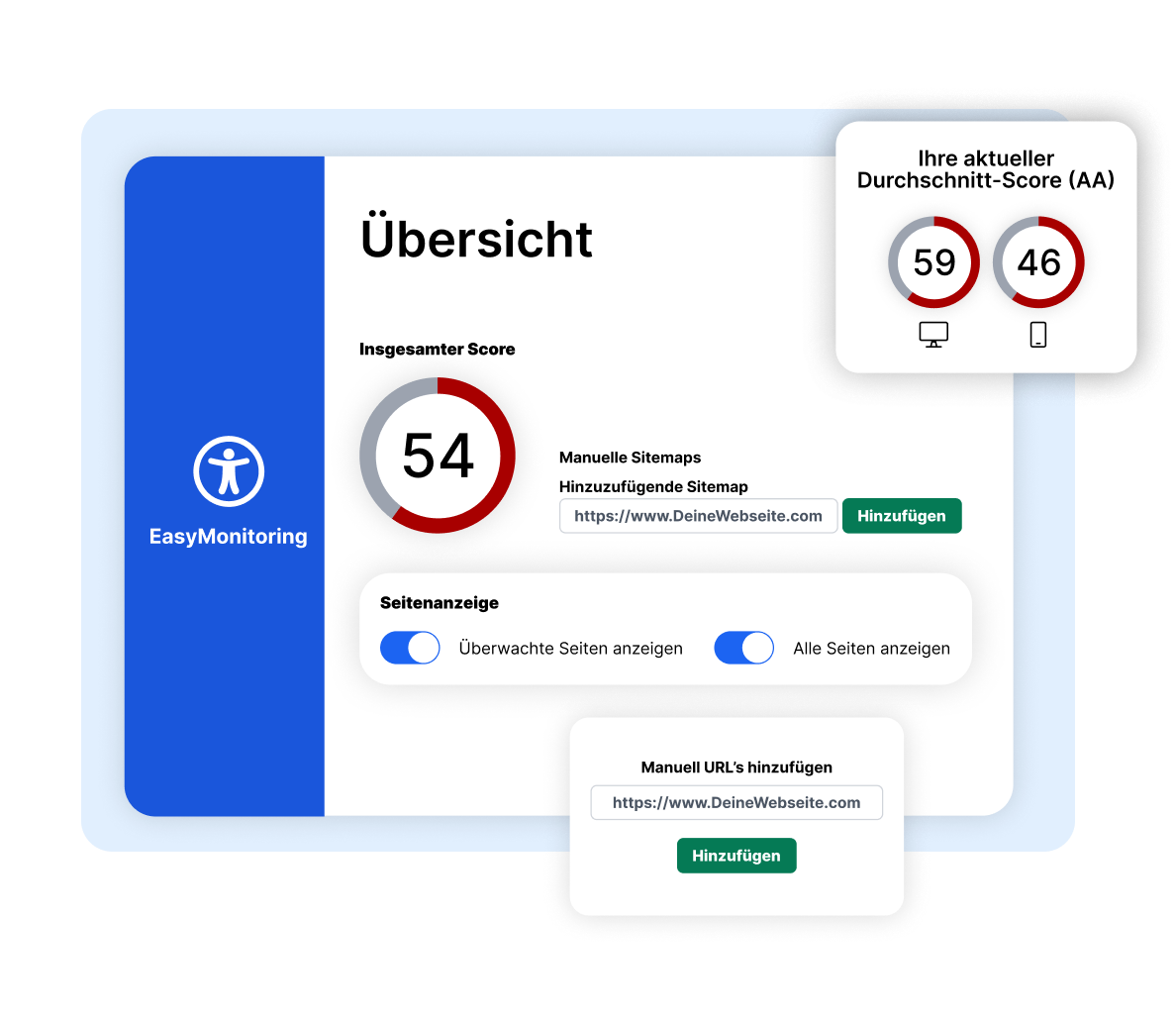
easyMonitoring: Fully automated auditing of your pages – with a score, error log and clearly prioritised tasks for BFSG-compliant implementation
-
easyStatement: BFSG-compliant accessibility statement – automatically generated, editable and available in multiple languages
-
easyVision: Visible assistive tools in the frontend for users with motor, visual or cognitive limitations – easily activated
Frequently asked questions about BFSG enforcement
The first warning letters began circulating in August 2025, around six weeks after the BFSG came into force. A second wave has been running since February 2026. Both waves are being sent by specialised law firms alleging that the respective website fails to meet accessibility requirements.